

Does each claim’s history change the reserve view?
Claims reserving beyond aggregate triangles
Find out whether claim histories and timing add useful information to your Chain Ladder benchmark, with a simulation you can audit.
Signs this is your problem
- Open claims with the same latest event have very different futures.
- Your aggregate triangle hides mix changes or development shifts.
- Committees ask for uncertainty, not just a point estimate.
What you receive
- Episode histories and benchmark comparison.
- Reserve simulation code and distributions.
- Backtest results and uncertainty diagnostics.
What we check
- Reconcile exposure and claims, then rebuild episodes and event timing.
- Keep your aggregate benchmark and define a comparable valuation scope.
- Evaluate a path-aware model, including VLSMC and Monte-Carlo simulation when justified.
- Review errors, uncertainty calibration and closure assumptions before use.
Rigour note. A lower estimate is not proof of better accuracy or of savings. We check it against later claim development before any recommendation.
Featured case study
All case studies →Health claims: clean data and a new reserving method
One engagement, two connected problems: rebuild reliable insurance data, then estimate remaining claim costs from the history and timing of each claim.
Read the case study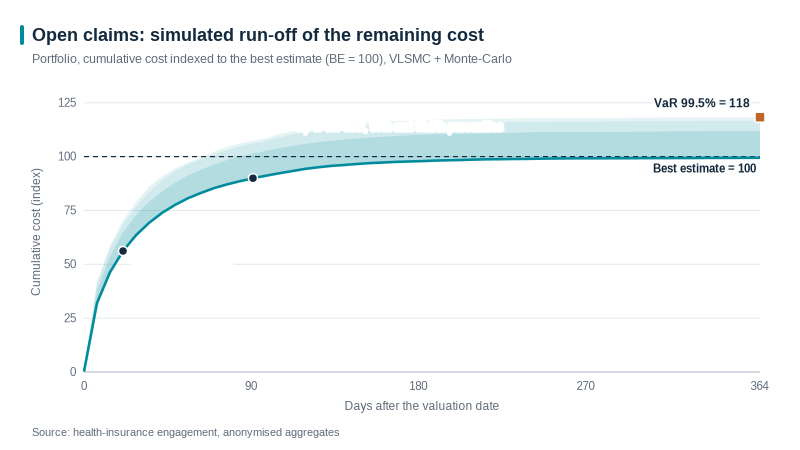
Key results
- 0.91 / 0.96
- total forecast-to-paid ratio at two sealed cuts; components biased in opposite directions, model not adopted
- 2 in 1
- data quality and reserving in one engagement
- Reused
- clean base adopted by the client’s BI team
Method notes
What we look at, why, and where the usual methods reach their limits.
When Chain Ladder works well
Chain Ladder assumes that each accident period develops like the ones before it: the same share of the ultimate cost is paid, or reported, at each age. When the portfolio mix is stable, claims handling has not changed and each cell holds enough claims, that assumption holds and Chain Ladder is hard to beat. It is transparent, quick to reproduce and easy to discuss with auditors. Bornhuetter–Ferguson adds an a priori loss ratio for the youngest periods, where development factors are most volatile, and Mack’s model gives a standard error around the estimate.
Where aggregate triangles lose information
A triangle keeps one number per accident period and age. It forgets which claims are open, how long they have been open, what has already happened to them and what kind of care or damage is involved. Two open claims with the same paid amount can have very different futures: one is about to close, the other is at the start of a long treatment. When the mix of such claims changes, or when claims handling speeds up or slows down, development factors drift and Chain Ladder projects yesterday’s pattern onto today’s portfolio. Calendar-year effects, such as inflation or a new settlement policy, are a classic source of error.
Aggregate or claim-level reserving
Claim-level reserving models each open claim from its own history: its events, their order and the time between them. The reserve is then the sum of simulated futures, which gives a full distribution rather than a point estimate. The price is data work: dated events, reliable claim identifiers and a clear definition of closure. That is why we always keep the aggregate method as the benchmark: the individual model has to explain where and why it differs.
Using each claim’s history and timing
A plain Markov chain looks only at the last event. A variable-length Markov chain looks back as far as the data justify: one step where history adds nothing, several steps where it changes what comes next. A semi-Markov layer also models the time spent in each state, so the model knows that a prenatal sequence follows a calendar of weeks while a physiotherapy course follows sessions. Monte-Carlo simulation of these paths gives the reserve and its percentiles, as in our health reserving case study.
Comparing two methods fairly
A lower reserve is not a better reserve. The comparison must use the same valuation date, the same scope of claims and the same definition of ultimate cost. The test that counts is out of time: freeze the data at a past date, project with both methods, and compare with what was actually paid afterwards. We also check that the uncertainty is calibrated, that is, that the 90% interval contains the outcome about nine times out of ten across periods.
The diagnostics we look at
Stability of development factors across accident periods; residuals by accident, development and calendar period; Mack’s standard error and the sensitivity to the tail factor; the share of the reserve carried by the youngest periods; and, for claim-level models, the closure rate and the number of simulated events against those observed. Each diagnostic is shown rather than summarised, so the reserving committee can challenge it.
Further reading
Beyond Chain Ladder: VLSMC, forecasting what comes next in a claim or a customer journey
Chain Ladder assumptions rarely checked (Mack, homogeneity, normality), a real health case, then VLSMC: claim-level reserves and customer journeys.
Read the articleClaims reservingWhen is a lower reserve estimate credible?
Same scope, a gap explained claim by claim, backtests at past dates and a difference larger than the uncertainty: when to believe a lower reserve.
Read the articleClaims reservingBacktesting claims reserves: how to know whether your reserving method works
Rebuild reserves at past valuation dates, compare actual with expected, check interval coverage and compare methods fairly, with a checklist.
Read the articleTo start the conversation
Valuation dates, claim and payment histories, and the Chain Ladder benchmark you use today.
Actuarial AI
Pricing, reserving, claims control and model validation, always compared with your current benchmark.
Questions before we start
How much history does claim-level reserving need?
Enough closed claims to learn how episodes unfold: in practice a few years of dated claim and payment events. Where history is thin, the model automatically shortens its memory.
Can you also deliver a classical reserving study?
Yes. Chain Ladder, Mack uncertainty and Bornhuetter–Ferguson are delivered on request, and they serve as the benchmark the claim-level model must beat.
When does Chain Ladder fail?
When the past no longer describes the future: a change in settlement speed or in case reserving, a change in business mix, calendar-year effects such as inflation, or thin cells and large claims. A speed-up of settlements alone can make it overstate recent years. Our article <a href="/vlsmc-variable-length-semi-markov-claims-customer-journeys/">Beyond Chain Ladder</a> shows each case.
How do you validate a claims reserve model?
By backtesting: the history is rebuilt as it was known at past valuation dates, the model forecasts what follows, and each part of what remains to be paid is judged against what was actually paid, together with the coverage of its intervals. See our <a href="/backtesting-claims-reserves/">article on backtesting reserves</a>.
Can we start with pseudonymised data?
Yes. The models need consistent identifiers, dates and amounts of claims and payments, not names: pseudonymised keys are enough as long as they are the same in every file.

Engagements led by Raphael Sebbah, actuary (ISUP) and data scientist, formerly at Amundi (CAAM), Dexia, AIG and Phoenix, co-author of peer-reviewed research.
Let’s build better decisions together
Tell us about the decision you need to make.
A few lines are enough: your sector, the data you have and what you want to improve. We reply personally with a first view of the approach.
- A few lines are enough
- NDA on request
- Code and documentation handed over