

Claims reserving
When is a lower reserve estimate credible?
A claim-level model often gives a lower reserve than Chain Ladder. Releasing reserves has real consequences, so the bar is high, and rightly so. Four conditions make a lower estimate credible: the same scope, a gap explained claim by claim, a method that was right at past dates, and a difference larger than the uncertainty.
Compare like with like
Most lower estimates shrink when the scope is aligned. Same claims, same valuation date, same definition of ultimate cost, same treatment of claim-handling costs, same discounting. A claim-level model of reported claims covers the reported claims only: claims incurred but not yet reported must be added, from a separate model, before it is compared with a triangle method that includes them. The same holds for a segment the new model leaves out, or for claims it treats as closed.
Explain the gap, claim by claim
A claim-level model can say where its difference comes from. Typical sources are claims that are open in the system but finished in reality, which Chain Ladder keeps developing; segments whose development has become faster than in the past; and large old claims that weigh on the triangle factors. Each source should be visible in a table and checked with the claims team. A gap that cannot be traced to claims is a warning, not a result.
Show that it was right before
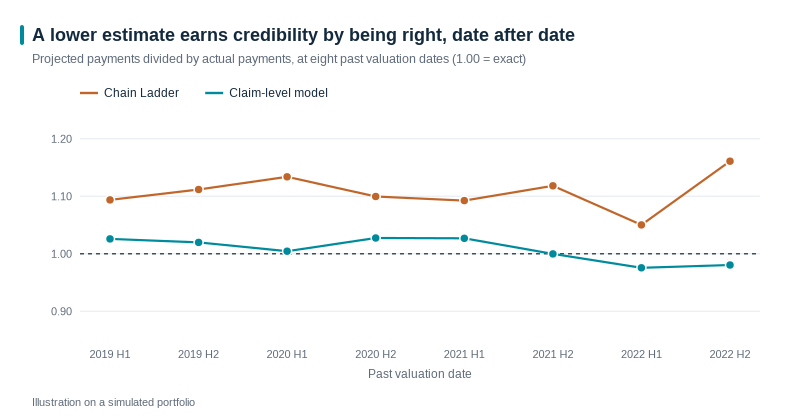
The strongest argument is a track record. Rebuild the data as known at several past valuation dates, run both methods with the rules in force today, and compare their projections with what was actually paid afterwards. A method that was lower and right at date after date is credible; a method that was lower once is not yet. Our article on backtesting reserves describes the traps, including the closure of claims and inflation.
Check the difference against the uncertainty
A difference smaller than the width of the reserve range cannot be read as an improvement. Report both distributions, their ranges, and how well those ranges covered the outcomes in the backtest. If the intervals do not cover as announced (in our backtest, those of the continuing payments were too wide), recalibrate them before drawing conclusions, as in our health reserving engagement.
A short checklist for the committee
Same scope, including late-reported claims and costs. A gap traced to identified claims and segments, confirmed by the claims team. A backtest at several past dates, with both methods and today’s rules. A difference larger than the uncertainty, with ranges that were well calibrated. A process explanation for why the past overstated: faster settlement, cleaner data, dormant claims closed. If one of these is missing, keep the higher estimate and document what would change the decision.
References
Directive 2009/138/EC (Solvency II), Article 83, “Comparison against experience”; T. Mack (1993), ASTIN Bulletin; M. Merz and M. V. Wüthrich (2008), CAS E-Forum.

Actuary (ISUP) and data scientist, founder of Smart Data Science. Formerly at Amundi (CAAM), Dexia, AIG and Phoenix; co-author of research published in The European Physical Journal C and Brain Communications.
More publications
PublicationsBacktesting claims reserves: how to know whether your reserving method works
Rebuild reserves at past valuation dates, compare actual with expected, check interval coverage and compare methods fairly, with a checklist.
Read the articleReserving and path modellingBeyond Chain Ladder: VLSMC, forecasting what comes next in a claim or a customer journey
Chain Ladder assumptions rarely checked (Mack, homogeneity, normality), a real health case, then VLSMC: claim-level reserves and customer journeys.
Read the articleCausal inferenceDid it work? Measuring the effect of a decision without fooling yourself
A campaign, a new deductible, a reminder letter: did it change the outcome? Comparing those who received it with those who did not answers a different question. This article shows how we estimate the effect of a decision on observational data, what each estimate assumes, why the usual estimator can fail when the decision is rolled out in waves, what we do when only a few units received it, and how we keep a study of many segments from finding effects that do not exist.
Read the articleLet’s build better decisions together
Tell us about the decision you need to make.
A few lines are enough: your sector, the data you have and what you want to improve. We reply personally with a first view of the approach.
- A few lines are enough
- NDA on request
- Code and documentation handed over