

Are some claims paid outside the contract?
Claims leakage and coverage audit
Find the money leaking through inconsistencies between coverage, claims and payments, with evidence your claims team can act on.
Signs this is your problem
- Claims and policy systems use different identifiers or dates.
- A payment looks valid in one table while its coverage is missing in another.
- Free-text labels hide the same act under many spellings.
What you receive
- Reconciled table, matching rules and audit trail.
- Prioritised exceptions with their evidence.
- A quality report your BI team can reuse.
What we check
- Map policy, exposure, claim and payment keys; document coverage rules.
- Normalise free-text labels with reviewed correspondence dictionaries.
- Reconcile joins and dates; separate absent records from failed matches.
- Review flagged payments with a business owner before any recovery.
Rigour note. A flag opens an investigation; it does not prove a payment was improper. Contract interpretation and recovery stay with you.
Featured case study
All case studies →Health claims: clean data and a new reserving method
One engagement, two connected problems: rebuild reliable insurance data, then estimate remaining claim costs from the history and timing of each claim.
Read the case study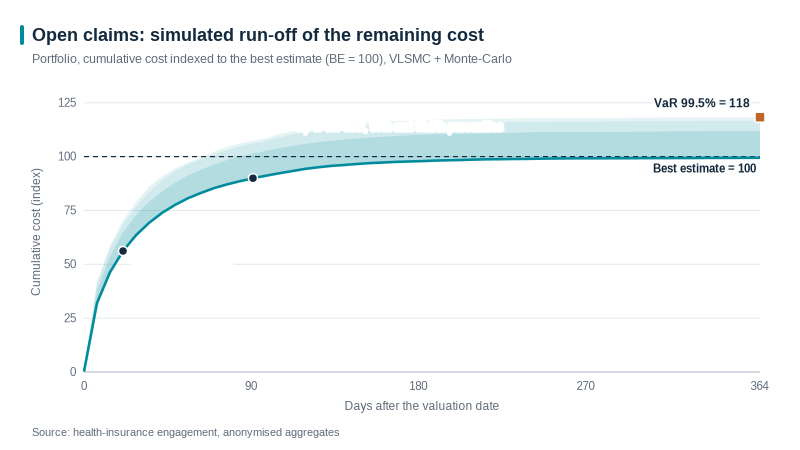
Key results
- 0.91 / 0.96
- total forecast-to-paid ratio at two sealed cuts; components biased in opposite directions, model not adopted
- 2 in 1
- data quality and reserving in one engagement
- Reused
- clean base adopted by the client’s BI team
Method notes
What we look at, why, and where the usual methods reach their limits.
Start from the contract, not from the payment
A payment can only be judged against the coverage valid on the date of care: effective dates, waiting periods, exclusions, limits per act or per year, and the members actually covered. We encode these rules first, with the claims team, so that each payment is tested against the contract as it stood, not as it stands today.
Matching is where errors hide
Claims, policy and payment systems rarely share an identifier: policy number in one, member number in another, a national ID in a third, with dates that differ by a few days. We build the matching with reviewed tolerances and keep two outcomes apart: a payment with no valid coverage, and a payment we simply failed to match. Mixing them produces false alarms.
Free text and repeated acts
The same act often appears under many spellings. Correspondence dictionaries, validated by claims experts, bring them together before any count. Repetitions beyond a contractual limit, unusual amounts for a provider and acts outside the usual care path then stand out, and the path-aware models used in our health engagement add the order in which acts occur.
From flags to recovery
Each flag carries its evidence and a priority that combines amount and confidence. A sample is reviewed by the claims team to measure precision before the rules are run at scale, and the decision to recover stays with the insurer. On one group health contract, this approach found more than ILS 1 million paid outside coverage.
Further reading
Claims leakage analytics: exposure, joins and what should not have been paid
Exposure–claim reconciliation, coverage and limit rules, duplicates and provider outliers, and how to turn leakage flags into recoveries.
Read the articleModel validationData leakage in insurance models: the future is the easiest feature to use by accident
A datum is admissible only if it was observable at the decision date: where the future hides in insurance files, why a random split hides it, what it caught in our work.
Read the articleData qualitySerendipity through rigour: the findings nobody was looking for
Domain checks, cross-variable rules, reconciliations and totals split by part: how consistency checks uncovered more than ILS 1 million.
Read the articleData qualityOne value, fifty spellings: dictionaries, fuzzy matching and human validation
A city typed in capitals, a product with a missing letter, “N/A” where nothing was known: free-text fields multiply the spellings of a few real values, and every analysis built on them inherits the noise. Cleaning them is not about making a machine “understand language”. It is about never letting a resemblance become a false business fact: certain rules first, a key that destroys nothing, similarity as a suggestion only, vetoes, and the last word to someone who knows the business.
Read the articleData qualityOne column, several populations: finding the real anomalies without flagging a second population
Payments around 100 and around 3,000 in one column: a usual detection flags the second group (55 of 55 values); ours recognises it and flags none.
Read the articleTo start the conversation
A sample of policy terms, exposure periods, claims and payments, plus your current matching rule.
Actuarial AI
Pricing, reserving, claims control and model validation, always compared with your current benchmark.
Questions before we start
Do you need access to individual claims?
Yes for the audit itself, under NDA. Personal identifiers can be hashed before the data reaches us.
What happens to the payments you flag?
Each comes with its evidence and a priority. The decision to recover stays with your claims team.
Related pages

Engagements led by Raphael Sebbah, actuary (ISUP) and data scientist, formerly at Amundi (CAAM), Dexia, AIG and Phoenix, co-author of peer-reviewed research.
Let’s build better decisions together
Tell us about the decision you need to make.
A few lines are enough: your sector, the data you have and what you want to improve. We reply personally with a first view of the approach.
- A few lines are enough
- NDA on request
- Code and documentation handed over