

Actuarial AI
Machine learning for actuarial teams, without losing the benchmark.
Your team already has methods it trusts. We show where cleaner data or a better model makes a measurable difference, and where your benchmark still wins.
What we solve
Pricing and segmentation
Align exposure, premium and claims; group sparse categories; compare GLMs on a consistent scope.
ExploreClaims reserving
Use claim histories and timing to challenge Chain Ladder with path-aware simulation.
ExploreClaims leakage audit
Reconcile payments with coverage and exposure periods to find claims paid outside the contract.
ExploreModel validation
Independent review of calibration, stability and leakage before a model goes to committee.
ExploreWhat we check
- Align policies, premiums, exposures and claims on the right periods.
- Prepare features: cleaning, grouping of levels, encoding and missing values.
- Compare GLMs, segmentations or simulations with an explicit benchmark.
- Review residuals, calibration, segment errors and validation limits.
Technical focus
Pricing and reserving models are judged on calibration by segment, stability from one year to the next and the absence of information leakage, always against your current method.
- GLM
- Tweedie
- GAM
- Chain Ladder
- Bornhuetter–Ferguson
- Mack
- VLSMC
- Calibration
- Stability
- Leakage checks
What your team keeps
- Controlled datasets and documented preparation rules.
- Versioned code, diagnostics and method comparison.
- Reserve simulations or monitoring tools where in scope.
- Documentation and handover to your team.
To start the conversation
The portfolio, the pricing or reserving question, the history available and your current benchmark. A description of the data is enough; no individual records are needed for a first call.
Featured case study
All case studies →Health claims: clean data and a new reserving method
One engagement, two connected problems: rebuild reliable insurance data, then estimate remaining claim costs from the history and timing of each claim.
Read the case study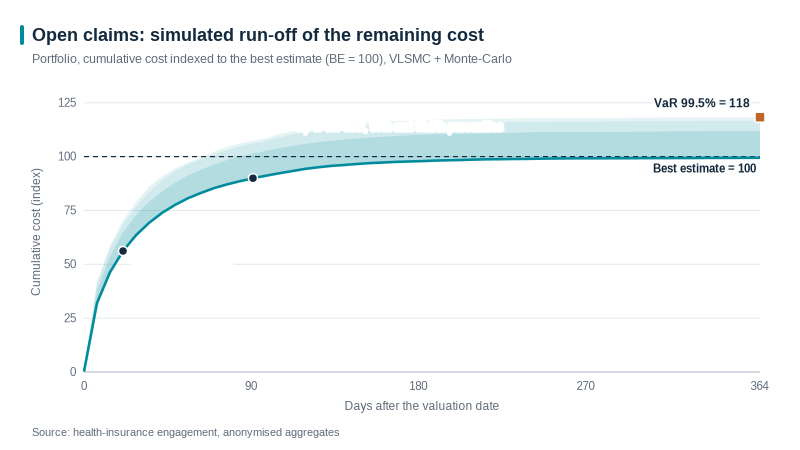
Key results
- 0.91 / 0.96
- total forecast-to-paid ratio at two sealed cuts; components biased in opposite directions, model not adopted
- 2 in 1
- data quality and reserving in one engagement
- Reused
- clean base adopted by the client’s BI team
Raphael’s ability to dig deep into data, analyse it rigorously and derive insightful conclusions is truly outstanding.
Further reading
Beyond Chain Ladder: VLSMC, forecasting what comes next in a claim or a customer journey
Chain Ladder assumptions rarely checked (Mack, homogeneity, normality), a real health case, then VLSMC: claim-level reserves and customer journeys.
Read the articleInsurance pricingGLM, GAM or gradient boosting: choosing a pricing model an insurer can defend
Which pricing model an insurer can defend: GLM relativities, smooth GAM effects, boosting as an interaction detector, and how to compare them.
Read the articleQuestions before we start
Can AI complement our existing actuarial models?
Yes. The aim is to test better features, segmentation or prediction against your current method, and document what improves and what does not.
What is actuarial machine learning?
Machine learning applied to actuarial questions: gradient boosting, GAMs or claim-level models for pricing, reserving and claims control, judged by the same standards as actuarial models: calibration, stability over time, interpretability and a comparison with the GLM or Chain Ladder benchmark on data the model has never seen.
Do you replace Chain Ladder or GLMs?
No. They stay as the benchmark. A new method is only recommended when its contribution survives validation.
How is our data protected?
We sign an NDA when needed, limit access to what the analysis requires, and hash or remove personal fields that are not needed.

Engagements led by Raphael Sebbah, actuary (ISUP) and data scientist, formerly at Amundi (CAAM), Dexia, AIG and Phoenix, co-author of peer-reviewed research.
Let’s build better decisions together
Tell us about the decision you need to make.
A few lines are enough: your sector, the data you have and what you want to improve. We reply personally with a first view of the approach.
- A few lines are enough
- NDA on request
- Code and documentation handed over