

Claims control
Claims leakage analytics: exposure, joins and what should not have been paid
Claims leakage is the difference between what an insurer paid and what it should have paid. It rarely sits in one system: it appears when policies, claims and payments are crossed. This article describes the controls that find it, how to turn flags into recoveries, and what such a review cannot do.
What leakage is, and why it hides
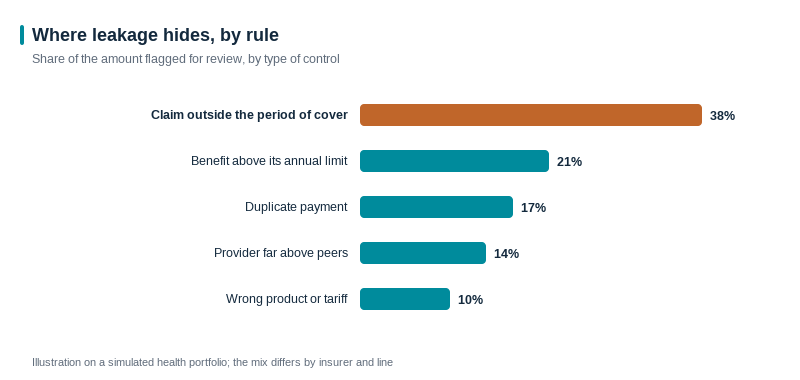
Leakage covers claims paid outside the period of cover, benefits paid above their limit, the same act paid twice, a wrong product or tariff applied, and amounts far above what comparable providers charge. Each system looks consistent on its own: the claims system has a valid claim, the payment system a valid payment, the policy system a policy that existed. The error appears only when the three are joined at the right level, with the right dates.
The controls that find it
Reconcile exposure and claims: was the person insured, under this cover, on the date of the loss? Apply the contract rules: annual limits, waiting periods, excluded acts, frequency caps per benefit. Detect duplicates on the same person, act, date and amount, including near-duplicates that differ by a few days or a rounding. Compare providers with their peers on price and frequency for the same act. And clean the labels first: the same act written ten different ways hides patterns, which is where text dictionaries help.
Exposure, computed rigorously
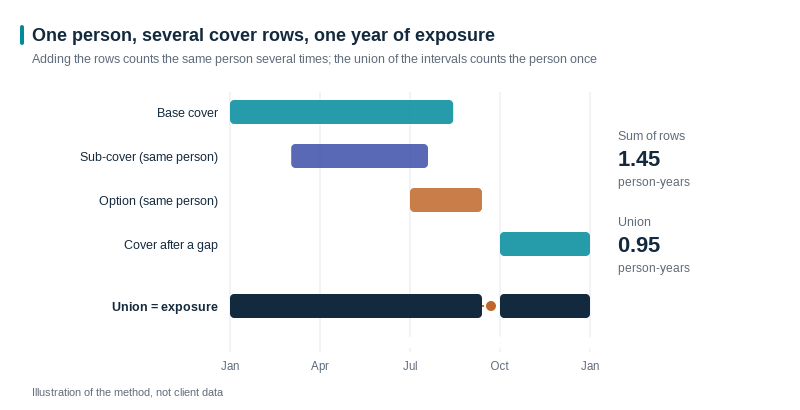
Most controls start with one question: was this person insured, under this cover, on the date of the loss? Answering it needs the exposure, the time during which each insured member was covered, and it does not come straight out of the policy file. On the group scheme where more than ILS 1 million came to light, the exposure table has one row per member and per cover, and a member holds on average eleven to thirteen covers at the same time: a base cover, sub-covers and riders. The exposure of a member therefore combines the rows of that member, one person-year per year, while the exposure of a cover is computed per member and cover. That amount came to light once the exposure of each member was computed correctly and the claims, contract and payment databases were joined correctly: some members had been paid for claims over periods when they were no longer insured. The most striking case was a retroactive cancellation: in February, a member cancelled the cover back to the previous September and was refunded the premiums from September to February; in October, inside that period, the member had reported a claim, which had already been paid. Once the cancellation is applied to the exposure, that claim falls in a period without cover: the claim was paid and the premiums for the same months were refunded.
Each row of a member is one cover over the period , from day included to day excluded. For a calendar period , writing for the number of days in a set of days , the exposure is the length of the union of the periods, never the sum of their lengths, in person-years when is a year:
The exposure of one cover combines only the rows of that cover, and its claim frequency divides by it, with the number of claims of cover that occurred in on a covered day:
The naive sum of the rows is never smaller than , and equals it only when no two rows of a member overlap within :
Three conventions are fixed once. A period runs from its first day included to its end day excluded, so an inclusive end date gets one day added; never a mix of both. Every period is bounded by the start of the study and by the extraction date, since a cover still open when the data were taken is exposed only up to that day. And the exposure is split at the birthday, so that the time before and after it goes to the right age; with the year of age of that member, from the birthday at which they turn included to the next one excluded, the exposure at age is:
The unit is the insured member, not the policy or the main subscriber. A family is often insured under one subscriber: on that scheme, about 41% of the members were children, 36% employees and 23% spouses, and more than half of the members appeared under several policy numbers over time. Keyed on the policy or the subscriber, a family collapses into one exposure or a member splits into several; keyed on the member, each person is counted once.
Joining claims to covers without creating or hiding money
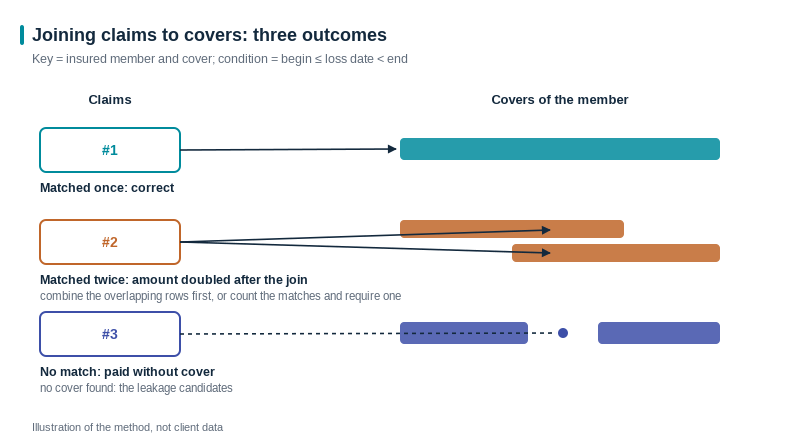
The reconciliation is a join: claims against covers, on the member and the cover, with the condition that the loss date falls inside the interval. Every claim is kept, whether a cover is found or not; the claims for which no cover of the member starts on or before the loss date and ends after it are the claims paid without a matching cover. Whatever the tool, they are set aside for review, never dropped.
Two traps make such a join create or hide money. If the cover rows of a member overlap, a claim matches twice and any amount summed after the join is doubled: combine the overlapping rows first, or count the matches per claim and require exactly one. And a join that keeps only the matched claims silently drops the unmatched ones, which are precisely the leakage: keep every claim and look at those without a cover.
From flags to recoveries
Controls produce flags, not recoveries. Rank them by expected amount times the probability that the flag is right, review a sample with the claims team to measure that probability rule by rule, and drop the rules that mostly raise false alarms. Then recover what can be recovered, fix the coding or the rule that let it through, and measure the amount recovered and the leakage that no longer occurs. In our health engagement, crossing claims, contracts and payments at a level of detail nobody had combined before helped recover more than ILS 1 million on a single group scheme. That check was not looking for leakage: the story is told in our article on serendipity through rigour and on our anecdotes page.
What a leakage review cannot do
Not every flag is an error: some payments outside the rules were agreed exceptions, and some apparent duplicates are genuine repeat treatments. Recovery depends on the contract, the law and the relationship with the provider or the client, so legal and claims teams decide, not the model. And a review finds what the data can show: an act coded correctly but medically unnecessary needs medical review, not analytics alone. Our claims leakage audit describes how we run such a review.

Actuary (ISUP) and data scientist, founder of Smart Data Science. Formerly at Amundi (CAAM), Dexia, AIG and Phoenix; co-author of research published in The European Physical Journal C and Brain Communications.
More publications
PublicationsSerendipity through rigour: the findings nobody was looking for
Domain checks, cross-variable rules, reconciliations and totals split by part: how consistency checks uncovered more than ILS 1 million.
Read the articleData qualityOne value, fifty spellings: dictionaries, fuzzy matching and human validation
A city typed in capitals, a product with a missing letter, “N/A” where nothing was known: free-text fields multiply the spellings of a few real values, and every analysis built on them inherits the noise. Cleaning them is not about making a machine “understand language”. It is about never letting a resemblance become a false business fact: certain rules first, a key that destroys nothing, similarity as a suggestion only, vetoes, and the last word to someone who knows the business.
Read the articleData qualityOne column, several populations: finding the real anomalies without flagging a second population
Payments around 100 and around 3,000 in one column: a usual detection flags the second group (55 of 55 values); ours recognises it and flags none.
Read the articleLet’s build better decisions together
Tell us about the decision you need to make.
A few lines are enough: your sector, the data you have and what you want to improve. We reply personally with a first view of the approach.
- A few lines are enough
- NDA on request
- Code and documentation handed over