

Case study · E-commerce
Hulken: from scattered platform reports to a data platform the company owns
A company selling close to $50 million a year with no data team, data spread across Shopify, Amazon and its ad platforms, and budgets steered by the ROAS that Meta and Google reported about themselves. In under three months, it had its own data platform, a true view of what drives sales, and a dashboard its executives use every day.
The starting point
Hulken sold close to $50 million a year without a single data person. Its data lived in many places: Shopify, Amazon, Meta Ads, Google Ads, TikTok, Pinterest, Klaviyo, Google Analytics. The company paid for partial reports from each revenue source, none of which agreed with the others.
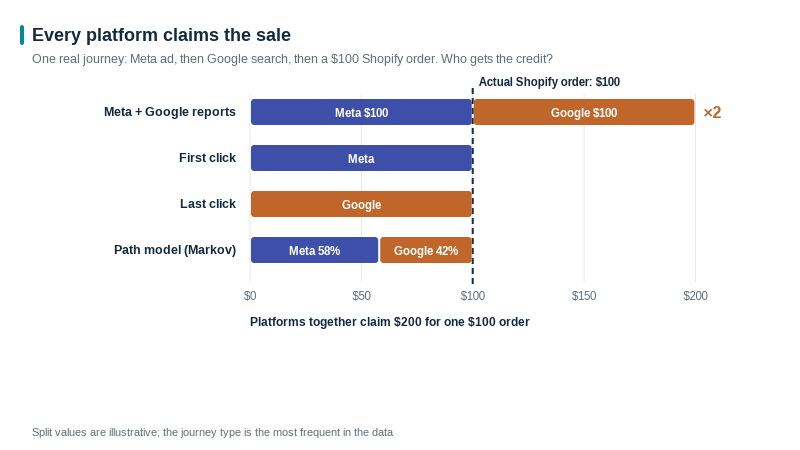
The performance figures at hand were the ROAS that Meta and Google reported about their own campaigns, each under its own attribution rules. Each platform credited itself with the sale, although a customer usually sees several channels before buying. Added together, the platforms claimed more sales than the company actually made.
The challenge
The goal was not another report. It was to make a mid-sized company autonomous: give its executives precise, instructive KPIs that match what they are used to seeing, without asking them to become data specialists, and let them steer the business on numbers they can verify.
One home for all the data
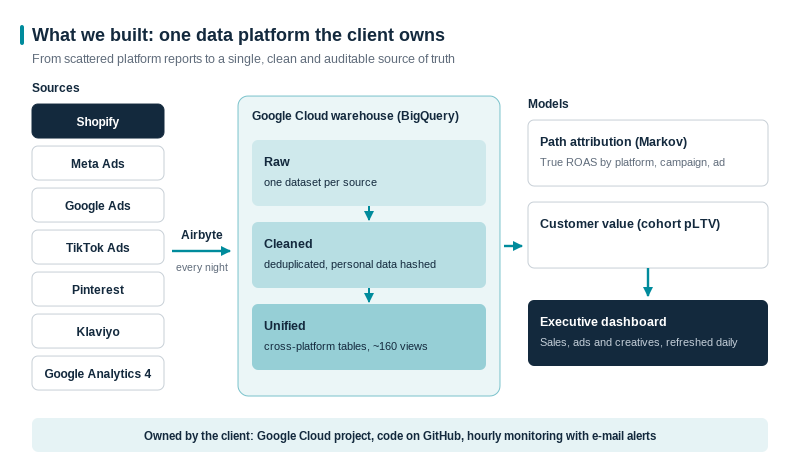
We built a cloud data warehouse on Google Cloud and connected every source to it with Airbyte. Each night, data from Shopify, the ad platforms, Klaviyo and Google Analytics is collected automatically; an hourly watchdog sends an e-mail alert if anything fails.
The pipeline then deduplicates the records, hashes personal data such as e-mails and phone numbers so that it is no longer identifiable, and builds unified cross-platform tables: about 160 clean views, ready to query.
Attribution that follows the customer’s path
With clean data in one place, we could rebuild each customer’s acquisition and purchase path. Shopify became the single source of truth for sales: the only verifiable record of what was actually sold.
Credit is then assigned along the path with the same variable-length Markov approach we use for insurance claims: completed journeys teach the purchase patterns, open journeys are scored for their chances of converting. The result is a true ROAS by platform, by campaign and by ad, and a clear view of where each extra dollar is best invested.
Customer value over time
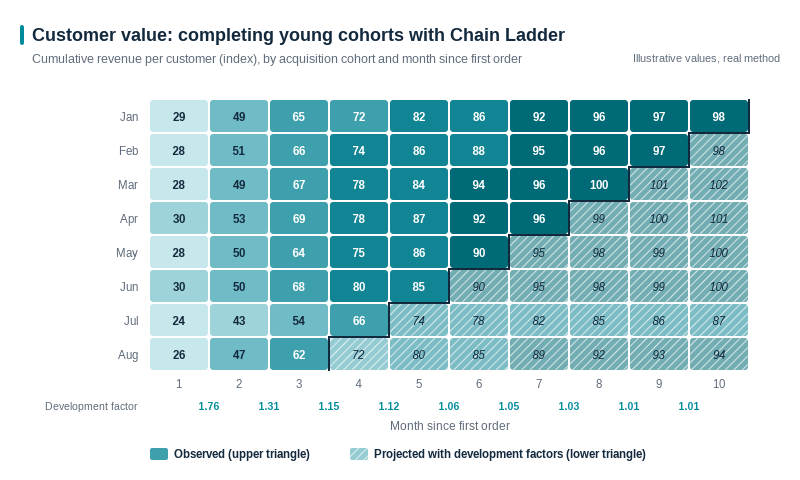
To judge acquisition properly, revenue has to be followed per customer cohort. Chain Ladder development factors, the actuarial reserving technique, complete the young cohorts from the mature ones and give a predictive lifetime value months earlier than waiting for the data.
A dashboard executives actually use
We built a custom dashboard, connected to Google Analytics as well, that follows sales, new ads and creatives day by day with the KPIs the team already speaks: revenue, orders, average basket, CAC, ROAS, but now computed from verifiable data. The company no longer has to take Meta’s or Google’s word for it.
Handover: the keys to their own data
Everything was handed over: the Google Cloud project and its data warehouse, the full code on GitHub, and plain-language documentation explaining how the data flows, what runs every day and what to do when an access key expires. From scattered reports to a solid, auditable data platform the company owns, in under three months.
Limits
Path attribution describes the journeys that were observed. Proving that a campaign created extra sales still requires a test, which the platform now makes possible to design and measure.
All case studies
Health claims: clean data and a new reserving method
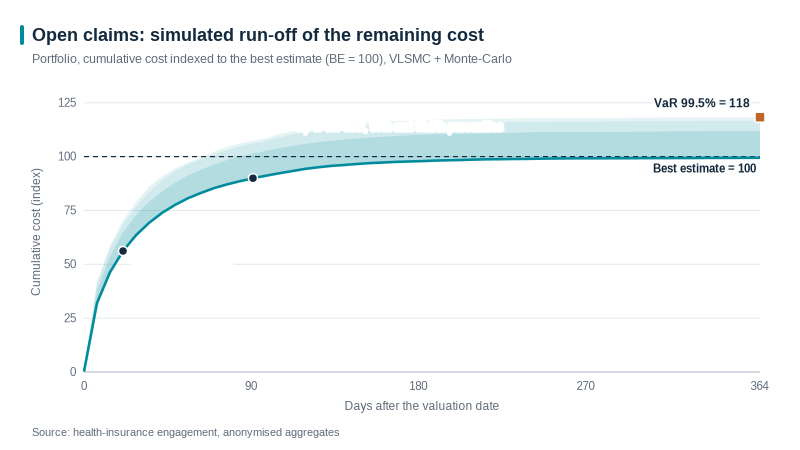
Health insurance case: rebuilt claims data and VLSMC reserving, a variable-length semi-Markov model of each claim path, tested out of time.
Data rebuilt · VLSMC reserving tested out of time
- Data quality
- NLP
- VLSMC
- Reserving
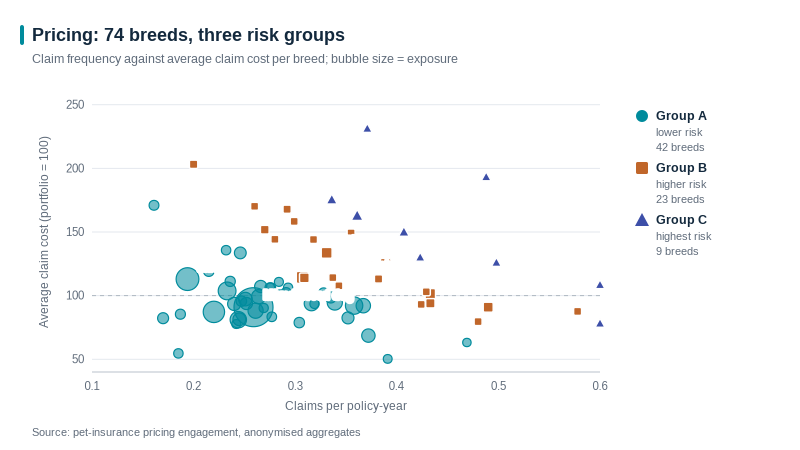
K-means and GLMs: pricing 74 breeds that did not fit one tariff
K-means grouped 74 breeds into three risk groups, revealing nine priced below cost (107% loss ratio), then fed frequency, severity and Tweedie GLMs.
9 breeds at a 107% loss ratio, now priced as a group
- K-means
- GLM
- Tweedie
Let’s build better decisions together
Tell us about the decision you need to make.
A few lines are enough: your sector, the data you have and what you want to improve. We reply personally with a first view of the approach.
- A few lines are enough
- NDA on request
- Code and documentation handed over