
Particle physics
AGANA and the data-directed search for new physics: finding an anomaly without knowing its shape
AGANA, the solution we proposed to the Weizmann team: detect departures from a symmetry of the Standard Model in ATLAS-like collision data by comparing two samples that should match, learning the distribution of symmetry-case differences with an autoencoder and sharpening it against a discriminator. The team accepted it and the project started with it; for the article published in The European Physical Journal C, it then took another route, a binned significance and a weakly supervised network. AGANA’s code and notebook are public on GitHub.
A search guided by the data
Searches for physics beyond the Standard Model are usually theory-driven and blind: a model of new physics is chosen, the analysis is designed for it, and the data are opened at the end. After hundreds of person-years, that approach has set impressive limits, but it also leaves large parts of the data unexplored. Prof. Shikma Bressler, the Weizmann Institute physicist we worked with, leads a complementary approach that her team calls the Data-Directed Paradigm: quickly flag the regions of data that depart from a well-established property of the Standard Model, so that dedicated analyses can focus there.
The property used here is lepton-flavour symmetry. In the absence of new physics, LHC data should be almost symmetric when prompt electrons and prompt muons swap roles: events where the muon carries more energy than the electron (μe) and the reverse (eμ) should occur about equally often. A persistent excess on one side could reveal, for instance, lepton-flavour-violating decays of the Higgs or Z boson.
Why the problem resisted
The data come as event maps: 28 × 28 grids counting events for the quantities under study, with backgrounds simulated as Poisson counts of different intensities. The signal has no known shape and may not exist at all, so it cannot be learned from labelled examples. And training one network per background would mean as many networks as possible backgrounds. The question had to be reformulated: detect an anomaly without knowing its form, and without assuming anything about the background.
Compare the maps instead of reading them
The key step is to work on differences. In the published method, two histograms that should match under the symmetry are compared bin by bin, the difference divided by the square root of their sum, and the binned significances are combined into one statistic, N_σ. Under the symmetry and Poisson counting, that statistic follows a standard normal law whatever the shape of the background, the approximation holding with at least 25 entries per bin; asymmetries of the detector itself have to be accounted for separately, and the article leaves them aside. A departure from symmetry shows up as structure in the difference, so the background never has to be modelled: tables, chairs or collision maps. AGANA feeds a network with the same differences, divided by six times the square root of the sum so that, under the symmetry, cells almost always fall within −1 and 1, the range of its tanh output; a cell beyond that would be a six-sigma fluctuation, rare but not excluded.
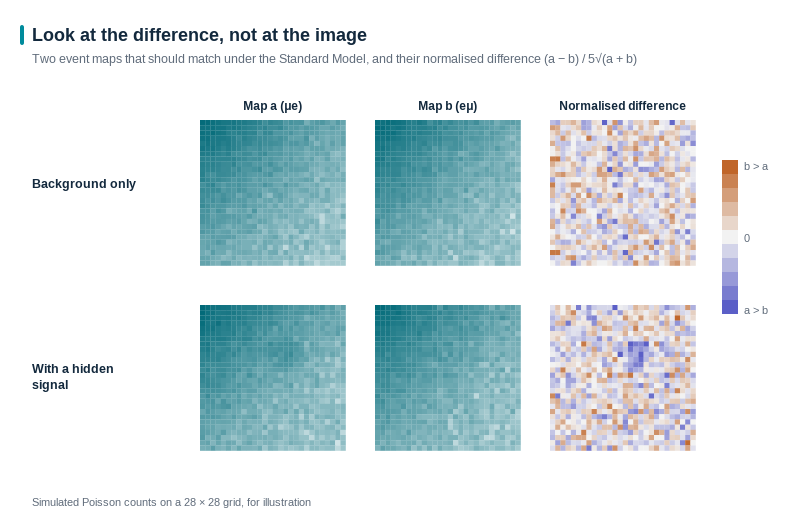
AGANA, step one: an autoencoder learns symmetry-case differences
AGANA is the solution we proposed, and the route the project started on. An autoencoder is a network trained to compress its input and rebuild it. Ours is convolutional: the encoder goes from one channel to 16, 32 and 64 feature maps with tanh activations, and the decoder mirrors it. Trained on background differences only, it rebuilds noise-like maps well and maps with structure badly, so its reconstruction error becomes an anomaly score.
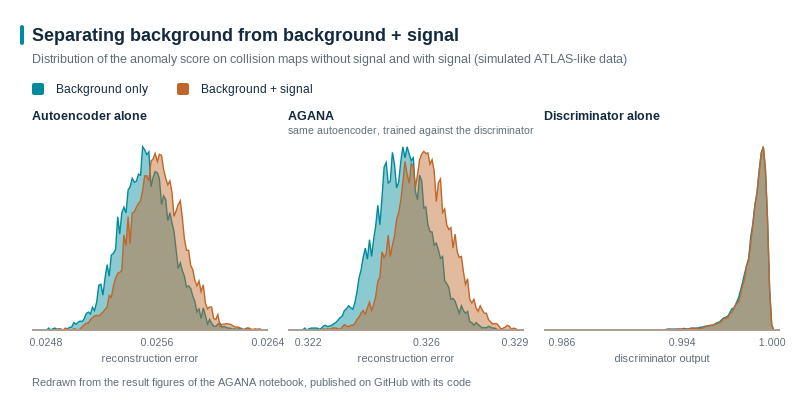
On its own, the separation was real but modest: the error distributions of background and background-plus-signal overlapped heavily.
AGANA, step two: the autoencoder against a discriminator
A generative adversarial network (GAN) sets a generator, which produces imitations, against a discriminator, which learns to tell them from real data; each improves by trying to beat the other. A GAN trained directly on the maps did not separate the two populations either: its discriminator scores piled up near one for both.
AGANA combines the two ideas. The pre-trained autoencoder takes the generator’s place and is trained against the discriminator. Pushed to produce reconstructions the discriminator cannot reject, it learns that distribution more precisely, and its error distributions separate much more clearly. The score distributions on simulated maps measured the separation, so the gain was quantified rather than judged by eye. AGANA answers the question it was built for: without using the signal shape or fitting the underlying background shape, on the simulated maps used for its evaluation, it separates the score distribution of maps with signal from that of maps without. The team accepted it as a working solution. When our time with the team ended, they continued along another route for the publication, described below; AGANA was not invalidated, and its code and notebook, with these results, are public on GitHub. The same architecture, an autoencoder trained in turn against a discriminator, was also published independently by another team for new-physics searches at the LHC: GAN-AE (Vaslin, Barra and Donini, Eur. Phys. J. C 83 (2023) 1008), evaluated in the LHC Olympics 2020 anomaly-detection challenge.
The published article took that other route. It combines the binned significances of the differences into one statistic, N_σ, and shows that a weakly supervised network, a classifier with three hidden layers of 50 units trained to tell the two samples apart, can also flag an asymmetry: if the samples differ only by fluctuations, it cannot separate them.
What it does and does not claim
The method flags where to look; it does not claim a discovery, and a search of this kind will by construction pick out regions shaped by fluctuations or by detector effects. Applied to real ATLAS data, a flagged region still requires a dedicated analysis with the full treatment of systematic uncertainties. Its value lies in widening the search: because it relies only on a symmetry and on differences, the same comparison principle can scan many final states that would never each receive a dedicated blind analysis, although the published weakly supervised approach may require a network for each selection.
The project and how it was unblocked, from the stalled monthly meetings to the idea of comparing images, are told in our Weizmann and CERN case study.

Actuary (ISUP) and data scientist, founder of Smart Data Science. Formerly at Amundi (CAAM), Dexia, AIG and Phoenix; co-author of research published in The European Physical Journal C and Brain Communications.
More publications
PublicationsPulsatile GnRH therapy in Down syndrome: the statistics behind a first-in-human trial
Seven patients, 1,260 imaging variables: paired tests, Benjamini–Hochberg correction and PCA behind a Brain Communications study at CHUV.
Read the articleData qualityOutliers in insurance data: error, or the claim that matters most?
Telling data errors from genuine large claims: signatures of errors, robust detection, capping and excess loading, extreme value theory.
Read the articleEconometricsHow to analyse a time series: an econometric protocol
Stationarity, ADF and Phillips–Perron tests, Zivot–Andrews breaks, Granger causality, cointegration and error correction, step by step with worked examples.
Read the articleLet’s build better decisions together
Tell us about the decision you need to make.
A few lines are enough: your sector, the data you have and what you want to improve. We reply personally with a first view of the approach.
- A few lines are enough
- NDA on request
- Code and documentation handed over